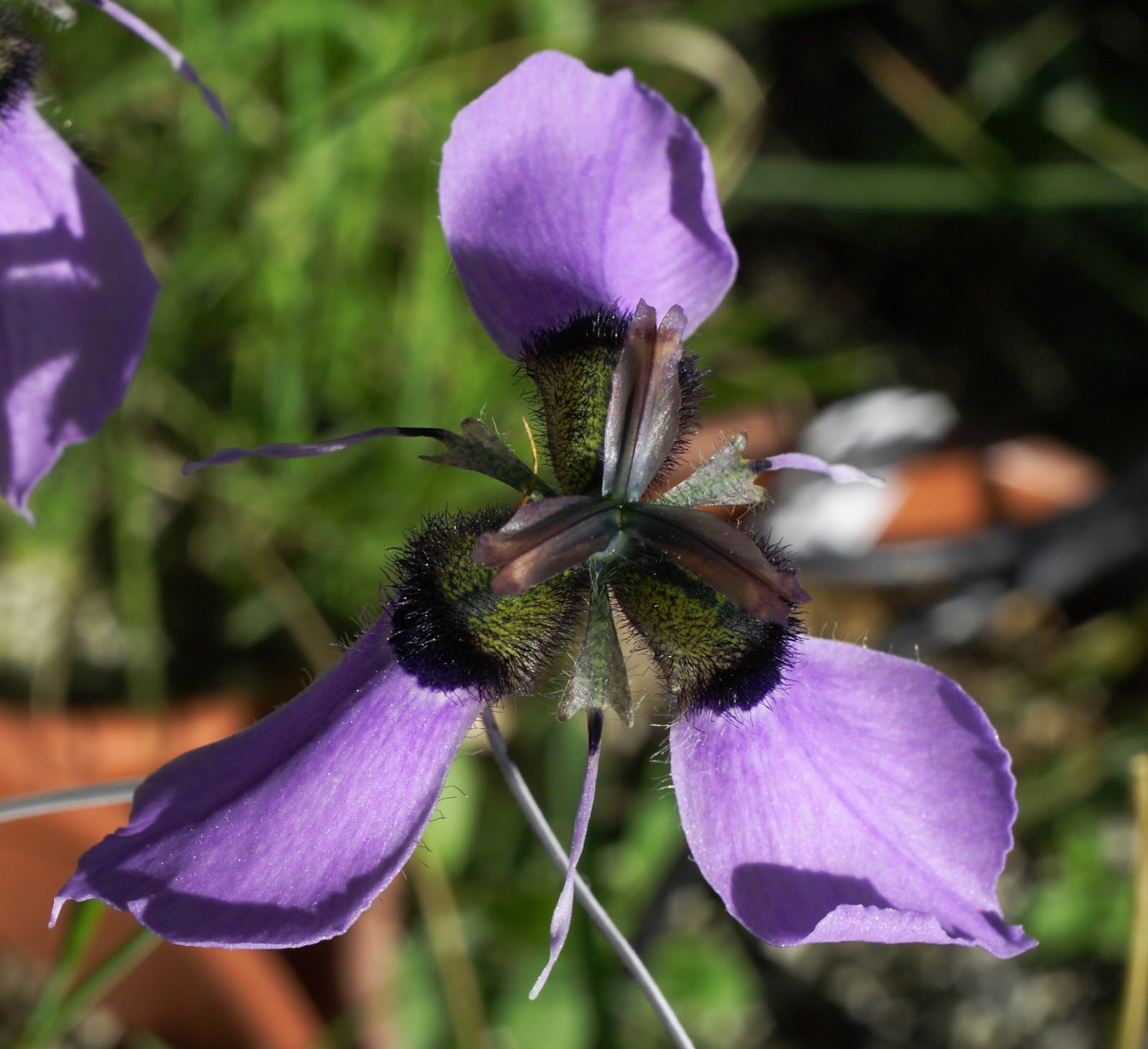
Seed parent: Moraea ciliata
Pollen parent: Moraea tricolor
A pale blue flower crossed with a bright pink one produced this nice magenta flower. Unfortunately, it has basically no reproductive parts (note the upright malformed style in the middle of the flower). Maybe sometime I can make this cross again to see if I can get a fertile one. In the meantime, this is a very pretty little flower.
MM 12-15a.
Saturday, June 3, 2017
Welcome!
Give a person a plant and they'll have a plant. Teach a person to grow a plant and they'll have an obsessive hobby that uses up their free time, backyard, and spare cash.
Don't say I didn't warn you.
Moraea hybrid MM 10-02c
This blog is about my favorite plants and how I grow them. My garden is a steep south-facing hillside at the southern edge of San Jose, California, about an acre in total. The soil here is heavy clay mixed with rocks, the water city-supplied and expensive.
My main focus in this blog is on unusual bulbs that can be grown in California.
Moraea hybrid MM 10-16d
These are not the bulbs you find in garden centers; they're amazingly colorful, sometimes weird looking, and almost always surprising.
You can grow these bulbs easily in any part of the world that has a Mediterranean climate, and with some care in just about anyplace else as well.
Moraea hybrid MM 11-15c
Gladiolus hybrid MM 00-00a
If you'd like to learn more, the sidebar at right lists my most popular posts and some other useful links. (If you're reading this on a smartphone, you probably can't see the sidebar, so I've reproduced the list at the end of this article.)
A color form of Calochortus superbus
I'd love to hear from you. Please feel free to post questions and suggestions. If you're just getting started, I'm glad to give advice. If you know about hybridizing, I need your advice!
I am also very interested in trading with anyone who has unusual Moraea species. My wish list is here.
Moraea neopavonia 'Summerfield'
I'm glad to share seeds of species and hybrid plants from my collection, free of charge. Other growers have been very generous with me, and I'd like to give back. Let me know if you want some.
Moraea hybrid MM 12-139b
I would be glad to hear from you:
That's a C between my first and last names. Yeah, I know, the spam-bots can probably read that. But why make their job easy?
Here's the list of my favorite posts:
New Moraea hybrids, 2024
New Moraea hybrids, 2022
New Moraea hybrids, 2021
New Moraea hybrids, 2018
New Moraea hybrids, 2017
New Moraea hybrids, 2016
New Moraea hybrids, 2015
New Moraea hybrids 2013-2014
New Moraea hybrids 2012 and earlier
Gladiolus hybrids
New Moraea hybrids, 2017
New Moraea hybrids, 2016
New Moraea hybrids, 2015
New Moraea hybrids 2013-2014
New Moraea hybrids 2012 and earlier
Gladiolus hybrids
How to grow Moraeas and other summer-dry bulbs
How to grow bulbs (on the Pacific Bulb Society website)
Growing bulbs from seed (Pacific Bulb Society)
How to grow bulbs (on the Pacific Bulb Society website)
Growing bulbs from seed (Pacific Bulb Society)
My Moraea species wish list (can you help?)
Finally, I'd like to say thanks to the many gardeners in the Pacific Bulb Society, the Indigenous Bulb Growers of South Africa, and the old International Bulb Society who have shared advice, encouragement, and plants with me over the years. In particular, Paul F.X. von Stein, who shared many seeds to get me started; and Moraea king Bob Werra, who gave me many of the bulbs that were parents to these hybrids.
Moraea MM 12-13
Seed parent: Moraea loubseri
Pollen parent: Moraea atropunctata
This one was fun! I think I was expecting a pale flower with purple spots, which is what happened when I crossed M. calcicola and atropunctata (MM 03-98).
Instead, I got these vivid purple flowers with no spots, but an orange center and a lot of hairs. These flowers bloomed a bit early in the Moraea season (March 11 here in San Jose, CA).
MM 12-13a.
MM 12-13b
MM 12-13c. Very similar to form b, but there are subtle differences in the inner tepals and center color pattern.
MM 12-13d. This flower bloomed for the first time in March 2020, eight years after the original cross was made. Most Moraea hybrids bloom for the first time at age three or four, so this one is a late arrival -- and it has a very interesting color pattern. I will be crossing this one with some speckled flowers to see what happens.
The flower below showed up in 2019. It's in a spot marked "MM 12-13," but it looks so different that I think it may actually be a chance seedling that dropped in this location.
Moraea MM 12-11
Seed parent: Moraea MM 03-98b (M. atropunctata X calcicola)
Pollen parent: Moraea neopavonia with dark eye
MM 12-11a. You can see some of the seed parent in the wide tepals and maybe the markings in the central cup, but otherwise it's a lot like the pollen parent. One change: The anthers are shorter than they are in the species.
Moraea MM 12-10
Seed parent: MM 03-05b (M. aristata X (atropunctata? x neopavonia))
Pollen parent: Moraea neopavonia with blue eye
I don't remember what I was looking to achieve with this cross. Perhaps I wanted to see whether the blue eye would be carried over into the hybrids. In that case, the answer is"no."
MM 12-10a. I like the two-tone orange coloring in this flower, although it's too bad there's no eye to speak of.
MM 12-10b. This one has an eye, but it's very dark, and otherwise the coloring is bland.
MM 12-10c. Very similar to form A, but the coloring of the style crests is different. These are light orange at the tip, while the crests in form A are cream.
Here are some more flowers that I haven't assigned letters to:
Moraea MM 12-09
Seed parent: Moraea gigandra
Pollen parent: MM 09-04a (M. atropunctata? X M. neopavonia) X (M. atropunctata? X M. neopavonia)
When I got the vivid yellow seed parent in 2009, I crossed it on a lot of other flowers to see what would happen. In this case, I ended up with some gigandra-shaped flowers with varying mixes of purple and yellow.
MM 12-09a. This one is very pale. Note the slight pale purple shading in the middle of the tepal. (I underexposed the photo so you could see the purple. Otherwise it photographs as dirty white.)
MM 12-09b. This one has more purple and more yellow in it. The result is a color that I can't easily describe. Yurple? Pyellow? It's also very hard to photograph accurately. I can't really call it beautiful, but it is very interesting.
MM 12-09c. Similar to form A, but the blue eye spot is a different shape and the dark spots in the central cup are arranged in bands.
This one, which bloomed in 2018, was labeled 12-09a, but it's obviously a sibling. I like the clear yellow color in the center.
Moraea MM 11-102
Seed parent: MM 99-00a (M. atropunctata? X M. neopavonia)
Pollen parent: Moraea gigandra
In terms of flower colors, this is cross is (cream x orange) X purple. That combination usually produces some mixed-color flowers, and sure enough this one did too.
11-102a. Pale cream with a tiny blue eye remnant.
11-102b. Another pale cream flower, this one with virtually no eye, just a slender dark ring.
11-102c. This is more like it: a nice medium purple flower with an orange and black throat.
Subscribe to:
Posts (Atom)