If you're new to this blog, you can start with the introduction here.

Thursday, April 18, 2013

Moraea neopavonia

To me, these are stunning flowers: brilliant orange and brilliant blue, with black freckles thrown in.

In captivity, the forms you usually see have a large or narrow blue eye, which is sometimes colored slate or black, or is absent altogether. Judging from online photographs and correspondence I've exchanged with folks in South Africa, there's a lot more variability in nature.

Botanists have merged Moraea neopavonia with a related species, Moraea tulbaghensis. Intermediate forms between the two species were found in the wild, and it became very difficult to tell them apart. I use the old name to identify my plants that have the forms shown here.

Big blue eye:

Narrow blue eye:

Gray-blue eye:

Black eye:

Some other variants:


Deeper orange color, big blue eye. I call this form 'Summerfield' in honor of Gordon Summerfield, the South African bulb grower who supplied it to me:


Eye almost missing:

Almost no eye, streaky tepals. I informally called this striking flower 'Sunrise.' Unfortunately, it died away after a few years, but it was a good pollen parent, and many of its offspring inherited its intense orange center. The bulb veterans always tell you, if you like a particular plant, propagate it. I've learned that lesson, to my regret, several times.

An intermediate form between M. neopavonia and M. tulbaghensis. Eye is bluish and flowers are fairly flat, but they're the smaller size typical of M. tulbaghensis, and are somewhat cupped. I think it's because of flowers like this that the two species were merged.

Thursday, April 11, 2013

Moraea MM 10-38

Seed parent: M. aristata
Pollen parent: Moraea MM 99-00

This was an attempt to re-create the cross that led to MM 03-05a, a flower that looks much like M. aristata but has a pale yellow background. I like that flower a lot, but it appears to be completely infertile. I was hoping for a fertile version of that flower.

The result was half-successful. These flowers have a pale yellow coloration to them (too pale), and they do appear to be at least somewhat fertile. Unfortunately, they don’t have the big blue and purple eye that makes MM 03-05a so special.

MM 10-38A has a very pale yellow color in the outer tepals, fading to white in the sun. The inner tepals and center are stronger yellow.

MM 10-38B is similar to A, but the eye is not as well formed.


MM 10-38C and MM 10-38D both look a lot like pure M. aristata. I wonder if maybe I got some aristata pollen onto this flower by accident...

Monday, April 8, 2013

Moraea mm 10-25

Seed parent: Moraea aristata
Pollen parent: Moraea mm 03-04a (aristata x calcicola)

I wanted to see if I'd get some odd recessive genes from this cross, but actually it looks very much like M. aristata. Maybe the tepals are a little broader, and the eys is less prominent, but if I didn't know this was a hybrid I'd probably assume it was M aristata. That's not surprising, I guess, since it contributed 3/4 of the total genes in the cross.

MM 10-25a

Tuesday, March 26, 2013

Moraea MM 10-03

Seed parent: Moraea gigandra
Pollen parent: Moraea MM 99-00 (atropunctata x neopavonia?)

As I've found in other cases, mixing an orange flower and a purple usually (but not always) produces a pale orange one. So the color in most of these plants does not resemble M. gigandra, but other characteristics show up.

The flowers have a moderate amount of pollen and may be fertile.

Compare these flowers to the flowers from the reciprocal cross, MM 10-16.

MM 10-03a is most notable for the distinct yellow ring around the center of the flower:

MM 10-03b has a small blue eye, reminiscent of M. gigandra:


MM 10-03c has a bluish dot where the eye would normally be:

MM 10-03d. Holy toledo, what's going on here? Flower breeders have all sorts of words for flowers that are almost but not quite red: burgundy, plum, old rose, etc. I think this one is plum-colored. Whatever word we use, it's interesting to me not just because of the color, but because there's nice contrast with the blue eye and orange center. This flower looks pretty promising to me.

MM 10-03e. This one is pale orange with no hint of yellow. I like the intricate dot pattern in the center.


How to Pollinate Moraea Flowers

There was a question on the Pacific Bulb Society mail list regarding how to pollinate a Moraea flower. It's a good question which confused me a lot when I got started, so I thought it might be useful to post something about it.

The two parts of the Moraea flower that you need to find are the anthers (the things that hold the pollen) and the stigmas (the places where you put the pollen).  In general, there are three anthers in every Moraea flower, and three pairs of stigmas (or stigmatic lips, as I've sometimes seen them called, because they look a bit like tiny lips or flaps).  Here is a diagram of a typical Moraea flower:


There's often a contrasting color spot on the flower that tells a pollinating insect where to go (the botanists call it a nectar guide; I call it an eye for short).  On the flower surface facing the eye you'll find the anther, which is usually a contrasting color and easy to spot because it has pollen on it (once the flower is fully open).  Just above the tip of the anther are two little flaps of tissue. These are the stigmas. Usually they are not a contrasting color, and they may be hard to spot.  You want to put the pollen on the inside of those flaps.

Sometimes the flaps may be stuck to the surface of the flower. If needed, you can pry them open with a very small camel's hair brush.

For a presentation, I once dissected a Moraea polystachya flower and photographed the parts.  I felt like a barbarian, but it was in the name of education, OK?

Here is the poor unsuspecting flower prior to surgery:

I have pulled off the outer tepals (if you're an iris grower, you call these the falls).  The anther is the dark purple vertical strip in the middle. It hasn't opened yet, so you don't see any pollen on it:

Now the anthers have been removed using tweezers:

The stigmas are labeled here:

Here's a closeup of a flower of Moraea gawleri that has been pollinated. The pollen is bright orange, so it's easy to spot:

Here are a few more examples. In Moraea gigandra, the stigmas are at the outer end of the central crest (this flower has been pollinated with orange pollen):

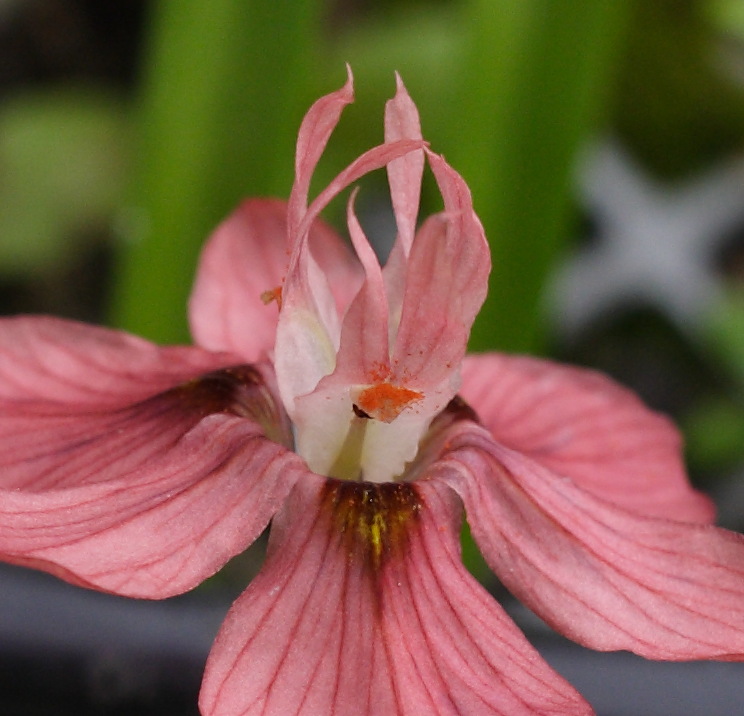
In Moraea neopavonia / tulbaghensis, the stigmas are small horn-like flaps at the end of the central crest. These have been pollinated:

In Moraea atropunctata, the stigmas are near the outer end of the crest:


How to transfer the pollen.  I like to use a small camel's hair brush; others favor a cotton swab. Or you can just use tweezers to rip off the anther and rub it on the stigma of the target flower.

If the flowers you need to cross do not bloom at the same time, you can store pollen in the freezer. I use small plastic film canisters for storage. If you live in a humid climate, putting some dessicant in the container is probably a good idea.


These flowers usually don't self-pollinate. In some Moraea species, the anther curls up and over the stigma, spreading pollen all over the place. I used to focus on removing the anthers before the flowers could self-pollinate, but after some tests I realized that most of the species I grow are not self-fertile. They need pollen from another individual to set seed, so all you have to worry about is bees and other insects (see below).


Watch out for bees. If you're serious about breeding Moraeas, you'll need to be careful about accidental pollination. It's no fun to grow seedlings for three years only to discover that they were pollinated by a bee with the wrong pollen.

In my garden in California, honeybees are attracted to the purple Moraeas (Moraea polystachya and M. villosa in particular). They don't bother the white and orange flowers, but if I don't protect the purple ones, the bees will pollinate them for me.

As the sequence below shows, the bees can be very persistent.  In this case, a bee is forcing open a flower of M. polystachya. In the process of fighting its way in there, it will spread pollen all over the place.


If you want to make a protected cross, you can either invest in making a screened cage, or pull off the outer tepals of the flower as it first opens (as illustrated in the dissection example above).  Without the outer tepals in place, the bees have no place to land, and the flower does not get pollinated.

Usually, because I'm lazy,  I do not bother to pull off the tepals. I just make sure I pollinate a flower before any bees get to it. I figure my pollen will probably dominate if it gets in there first, and I use a lot of it. A truly professional breeder would be appalled.

Sunday, March 24, 2013

Moraea mm 11-161

Seed parent: MM 99-00b (atropunctata x neopavonia?)
Pollen parent: MM 03-99a (neopavonia x villosa)

This cross was pure experiment; I wanted to see what would happen if I crossed these two orange hybrids.

MM 11-161A is about what you'd expect: it looks like a pale form of Moraea neopavonia.

MM 11-161B was a huge surprise. In person it's more of a mahogany color than this photograph suggests, but still it feels like a step in the path to a red Moraea.

Moraea calcicola

Known from just a handful of locations near Saldanha, South Africa, this one is rarely offered on the seed lists. It's not as spectacular as some of the other Peacock Moraeas, but it's an elegant-looking flower, and the plant is easy to grow.

It's native to summer-dry zone B4, a mild desert with little frost. Comparable cities are Alexandria, Egypt; Lazaro Cardenas, Mexico; and Illapel, Chile. For more information on the zones, click here.


This form has a smaller, lighter eye at the center. Also note the strange yellow-green color at the center of the flower. The only other species that has something like this is M. loubseri.