Seed parent: Moraea MM 99-00a (atropunctata x neopavonia)
Pollen parent: Moraea MM 03-05c (aristata x (atropunctata x neopavonia))
There’s not much to say about this hybrid. It is mostly cream-colored, with a pale yellow center and extremely long inner tepals.
MM 11-122a
Saturday, April 5, 2014
Moraea MM 11-50
Seed parent: Moraea MM 03-98c (atropunctata X calcicola)
Pollen parent: Moraea MM 03-05c (aristata X (atropunctata x neopavonia))
This is a very complex hybrid combining four species. One parent is light orange, while the other is light purple.
Compare this flower with MM 11-66 and MM 11-82.
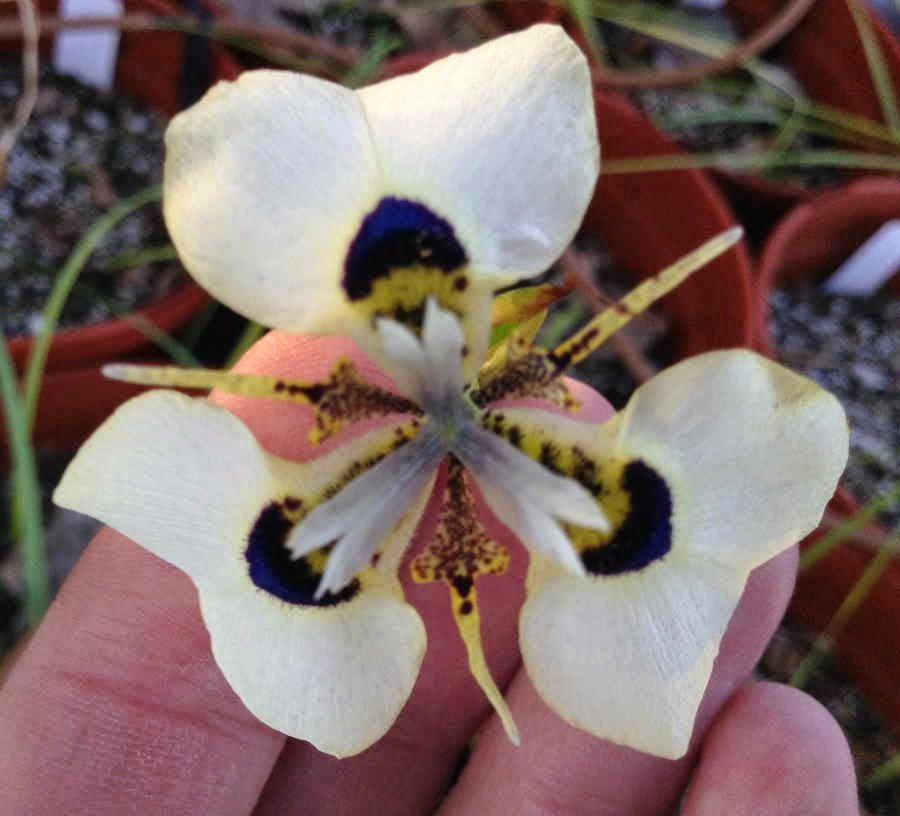
MM 11-50a. This flower is cream-colored, with a bit of yellow in the center, and very dense purple spots on the backs of the tepals. The spots are so intense that they show through the front of the tepals a bit, making them look slightly mottled. There are also a couple of little purple color flecks on the upper surface of the tepals.
You get the feeling that this plant is on the verge of turning polka-dotted all over. I crossed it with some other semi-spotted flowers; we’ll see what happens.
One of the best features of this plant is the incredibly long sword-shaped inner tepals, in pale yellow freckled with purple.
MM 11-50b. This one is white, with a nice blue eye and a few spots on the front of the tepals. I long to cross this one with its sibling form a, but I need them to bloom in the same year, which has yet to happen as of 2015.
Pollen parent: Moraea MM 03-05c (aristata X (atropunctata x neopavonia))
This is a very complex hybrid combining four species. One parent is light orange, while the other is light purple.
Compare this flower with MM 11-66 and MM 11-82.
MM 11-50a. This flower is cream-colored, with a bit of yellow in the center, and very dense purple spots on the backs of the tepals. The spots are so intense that they show through the front of the tepals a bit, making them look slightly mottled. There are also a couple of little purple color flecks on the upper surface of the tepals.
You get the feeling that this plant is on the verge of turning polka-dotted all over. I crossed it with some other semi-spotted flowers; we’ll see what happens.
One of the best features of this plant is the incredibly long sword-shaped inner tepals, in pale yellow freckled with purple.
MM 11-50b. This one is white, with a nice blue eye and a few spots on the front of the tepals. I long to cross this one with its sibling form a, but I need them to bloom in the same year, which has yet to happen as of 2015.
Moraea MM 11-158
Seed parent: Moraea MM 03-98b
Pollen parent: Moraea villosa form a
Pedigree: (atropunctata x calcicola) X villosa form a (purple tepals, blue eye, orange center)
Moraea villosa often dominates the appearance of flowers where it’s one of the parents, and this is a great example. If MM 03-98b were not the seed parent, I would assume this was a self-pollinated villosa. It’s hard to see what, if anything, MM 03-98b contributed to this plant. Maybe the tepals are a bit fuller than the usual villosa.
MM 11-158a
Pollen parent: Moraea villosa form a
Pedigree: (atropunctata x calcicola) X villosa form a (purple tepals, blue eye, orange center)
Moraea villosa often dominates the appearance of flowers where it’s one of the parents, and this is a great example. If MM 03-98b were not the seed parent, I would assume this was a self-pollinated villosa. It’s hard to see what, if anything, MM 03-98b contributed to this plant. Maybe the tepals are a bit fuller than the usual villosa.
MM 11-158a
Moraea MM 11-41
Seed parent: Moraea 03-98c
Pollen parent: Moraea villosa form b (purple tepals, blue eye, yellow center)
Pedigree: (atropunctata x calcicola) X villosa form b
This cross looks mostly like villosa, as commonly happens when that species is involved. But the central cup has the atropunctata look from its seed parent, and the eye is very dark blue. I also like the pale ring around the eye.
Overall, this plant has a clean streamlined look that I like, even though the colors are not spectacular.
MM 11-41a
Pollen parent: Moraea villosa form b (purple tepals, blue eye, yellow center)
Pedigree: (atropunctata x calcicola) X villosa form b
This cross looks mostly like villosa, as commonly happens when that species is involved. But the central cup has the atropunctata look from its seed parent, and the eye is very dark blue. I also like the pale ring around the eye.
Overall, this plant has a clean streamlined look that I like, even though the colors are not spectacular.
MM 11-41a
Moraea MM 11-24
Seed parent: Moraea villosa form A (purple tepals, blue eye, orange center)
Pollen parent: Moraea gigandra
Nothing about this flower looks at all like M. gigandra, so I wonder if it might be a selfed version of M. villosa. The bees work over M. villosa pretty thoroughly, so self-pollination is always a potential problem. On the other hand, M. villosa often dominates first generation crosses, so it could be that the gigandra genes are hiding in the background.
The flowers have more prominent veins and a darker eye than the seed parent.
I’ve made several other crosses with these same parents, so I’ll have to wait and see if they all look the same.
MM 11-24a
Pollen parent: Moraea gigandra
Nothing about this flower looks at all like M. gigandra, so I wonder if it might be a selfed version of M. villosa. The bees work over M. villosa pretty thoroughly, so self-pollination is always a potential problem. On the other hand, M. villosa often dominates first generation crosses, so it could be that the gigandra genes are hiding in the background.
The flowers have more prominent veins and a darker eye than the seed parent.
I’ve made several other crosses with these same parents, so I’ll have to wait and see if they all look the same.
MM 11-24a
Moraea MM 10-39
Seed parent: Moraea aristata
Pollen parent: Moraea villosa “with blue-green eye” (probably villosa c)
As has happened with other crosses between villosa and aristata, the flowers look mostly like a larger version of villosa. The tepals are almost pure white.
MM 10-39a has a blue eye and orange center.
MM 10-39b has a lemon yellow center and a blue eye edged in purple on the outside. Form B is the closest I’ve come to getting the aristata eye pattern on a larger flower, so I’m doing more breeding with it.
Pollen parent: Moraea villosa “with blue-green eye” (probably villosa c)
As has happened with other crosses between villosa and aristata, the flowers look mostly like a larger version of villosa. The tepals are almost pure white.
MM 10-39a has a blue eye and orange center.
MM 10-39b has a lemon yellow center and a blue eye edged in purple on the outside. Form B is the closest I’ve come to getting the aristata eye pattern on a larger flower, so I’m doing more breeding with it.
Thursday, April 3, 2014
Moraea MM 11-54
Seed parent: Moraea MM 03-99
Pollen parent: Moraea gigandra
Pedigree: (neopavonia x villosa) X gigandra
MM 11-54a
At first glance the flower looks like M. gigandra, but the tepals are violet (species gigandra is a deep blue-purple). And the central cup has some orange neopavonia color in it.
This is a handsome-looking flower in person, and I look forward to doing more breeding with it.
Pollen parent: Moraea gigandra
Pedigree: (neopavonia x villosa) X gigandra
MM 11-54a
At first glance the flower looks like M. gigandra, but the tepals are violet (species gigandra is a deep blue-purple). And the central cup has some orange neopavonia color in it.
This is a handsome-looking flower in person, and I look forward to doing more breeding with it.
Subscribe to:
Posts (Atom)